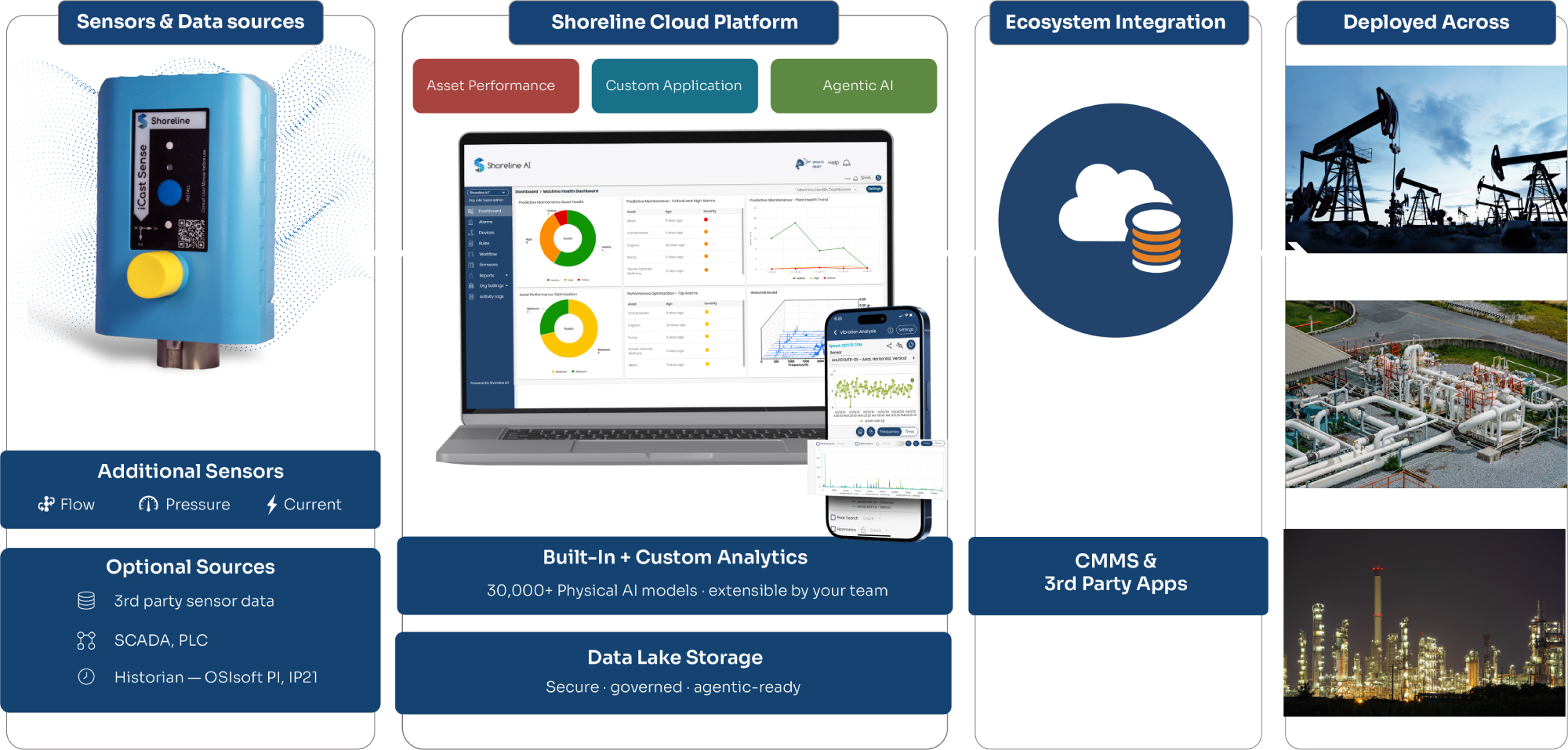
Shoreline’s plug-and-play asset performance management delivers breakthrough simplicity and cost efficiencies. Completely self-installed by non-experts, smart sensors automatically connect to the cloud and are auto-provisioned via a rich library of 30,000+ pre-built asset physics models.

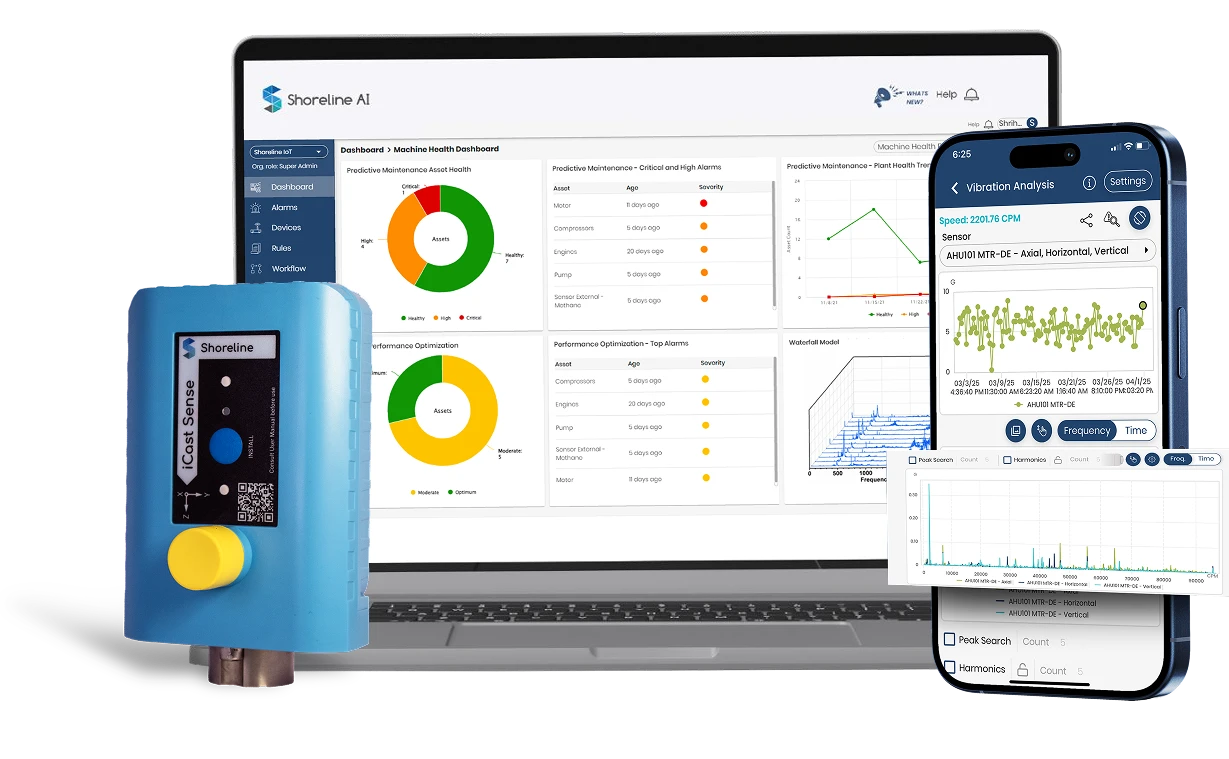
An end-to-end solution that includes self-installed smart sensors, 30,000+ pre-built Physical AI models, and human-in-the-loop analytics — deployed in a week, integrated with your CMMS, and running on the same secure infrastructure trusted by 5 of the top 10 US energy operators.

to first insight
subscription pricing
sensor direct to cloud
Optimized for agentic AI development and deployment at scale

EDGE
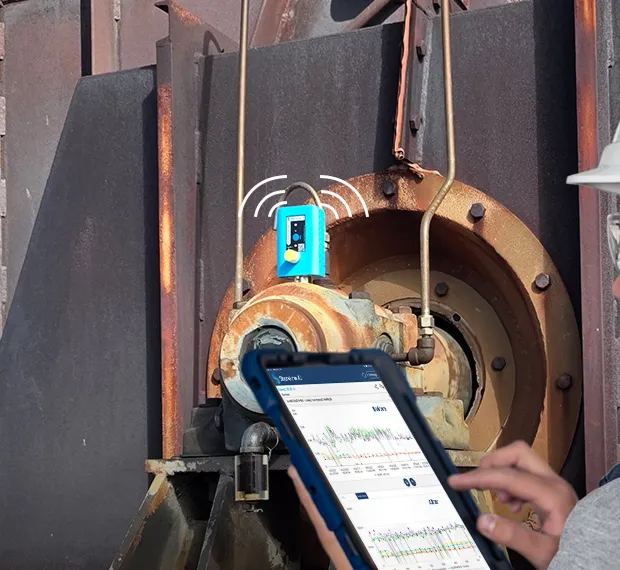
Shoreline sensors are glued/magnet-mounted by plant staff in under two minutes per asset. Preloaded physics models auto-provision to the cloud on first power-on — no gateways, no wiring, no conduits, no site survey. Edge Compute and Inference, so raw vibration, sound and temperature data is processed before transmission — reducing bandwidth costs and enabling response times that would be impossible with cloud-only architectures.
Per-sensor install time
Battery life on standard duty
Hazardous-area rated, Oil & Gas environment
Direct-to-cloud, no gateway, no wires

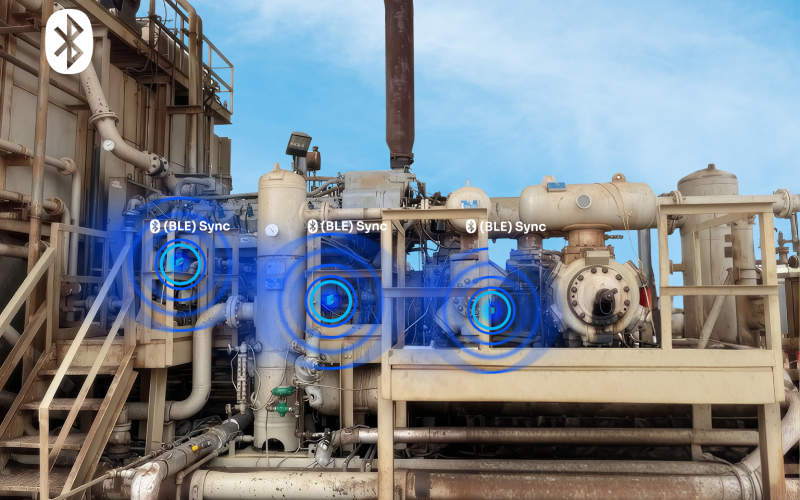
Wireless sensors wake on their own schedules, so captures across a powertrain can land a minute apart. At 1200 RPM that is 1,200 revolutions of drift — which makes phase comparison between measurement points impossible. And phase is what separates misalignment from unbalance, locates a heavy spot, and times an impact against crank angle. IntelliSync locks a sensor cluster to under 100 microseconds, roughly one degree of shaft rotation, so a wireless deployment can do the phase work that used to require a wired multi-channel analyser.

Capture sync across a sensor cluster
Of shaft rotation at 1200 RPM
Sensors phase-locked per powertrain
Developed in-house at Shoreline
Angular misalignment shows as a phase shift across the coupling. Without synchronised capture you see an elevated 2× peak and infer the rest. With it, the phase relationship between driver and driven end names the fault directly.
With a keyphasor reference, impacts can be placed against crank angle rather than merely counted. That distinguishes a suction valve event from a discharge valve event on the same cylinder.
Knowing where in the rotation an impact falls, not just that one occurred. Looseness, rubs, and valve events separate cleanly once every sensor shares a clock.
Why a pre-built model library changes the deployment math

SHORELINE CLOUD
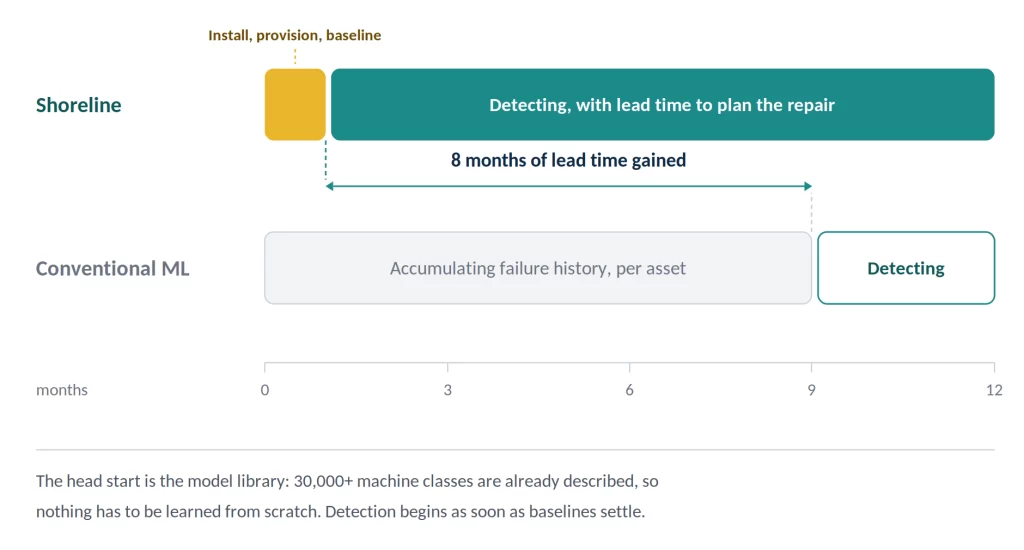
Every asset type Shoreline monitors has a pre-built Physical AI model — a physics-informed digital representation of the machine, its failure modes, and its normal-operation signatures. When a sensor comes online, the platform auto-matches the asset to its model and begins meaningful anomaly detection immediately.
The competitive alternative — waiting six months to a year to accumulate enough historical data to train a machine learning model per asset — is not required. Shoreline customers detect real faults in their first week.
PHYSICS MODELS IN ACTION
The exact failure mode, on the specific asset class, in the language reliability engineers speak. Every mode below is a physics-informed anomaly detection — the model knew what could go wrong before the sensor ever saw a fault. This is just a representative list, there are 30,000+ physics models cover many equipments. There are additional failure modes introduced when we get process data ingestion from Pi/SCADA systems and sensors through the input port on our Smart Sensor.
Each anomaly detection maps to a physics-based failure mode in the model library — no black-box anomaly scores, no post-hoc explanations. When Shoreline flags “outer race bearing wear on Blower B-2,” it’s because the model recognized the exact BPFO signature the physics predicted. Reliability engineers get a diagnosis they can act on, in language they already speak.
Cloud
Shoreline’s diagnostic suite combines AI-driven anomaly detection with a human-in-the-loop review process. When the AI flags a potential fault, a Shoreline reliability expert — most with 15+ years of vibration analysis or rotating-equipment experience — reviews the signature and validates the finding before it reaches your maintenance team.
The result: alarms operators actually trust. False positives are the reason most CBM programs get abandoned. Shoreline’s human-in-the-loop model brings the false-positive rate to a fraction of pure-AI systems.
False-positive rate
Monitored by experts
Avg. analyst experience
Compressor C-4 · unusual FFT peak at 122 Hz · confidence 87%
CAT IV Vib. Analyst confirms: outer race bearing wear signature
Work order created · replace bearing · 14-day window · $420K avoided
Total time from anomaly to work order: 11 minutes
Enterprise systems integrations
Shoreline pushes validated insights and work orders directly into the systems your reliability and operations teams already use — no rip-and-replace, no parallel dashboards to check.
Work orders auto-created with fault, priority, and remaining useful life.
SAP · IBM Maximo · Oracle · MaintainX · GE APM
Bidirectional data flow — pull process context, push condition scores.
OSIsoft PI · AVEVA · GE Proficy · Aspen IP.21
REST endpoints, webhooks, and streaming events for custom integrations.
OpenAPI 3.0 · OAuth 2.0 · Kafka streams
FRICTIONLESS ONBOARDING
While traditional APM deployments drag on for months or years, Shoreline operationalizes across entire facilities within weeks. Here’s what happens after the sensors arrive.
WEEK 1
Self-installed by mechanics < 5 minutes per sensor with an industrial adhesive puck. No specialized vibration consultants or third-party installers required.
Zero downtime — sensors mount directly on running compressors, pumps, and engines.
Zero IT overhead — pre-activated cellular radios connect direct-to-cloud. No gateways, no power cabling, no conduit, no site networking changes.
WEEK 2
Mobile-app pairing — technicians pair sensors and configure machine powertrains in minutes via the Shoreline Mobile App.
Immediate baselines — 30,000+ pre-built Physical AI models auto-configure asset parameters, vibration bands, and thresholds.
No historical data required — monitoring begins immediately, not after 6 to 9 months of failure-data collection.
WEEK 3-4
Self-installed by mechanics < 5 minutes per sensor with an industrial adhesive puck. No specialized vibration consultants or third-party installers required.
Zero downtime — sensors mount directly on running compressors, pumps, and engines.
Zero IT overhead — pre-activated cellular radios connect direct-to-cloud. No gateways, no power cabling, no conduit, no site networking changes.
RAPID TIME-TO-VALUE
Most energy operators realize full return on investment within 3 months by eliminating unplanned shutdowns and preventing secondary machine damage — while traditional APM deployments are still in configuration.
Same platform, deployed where customers asked us to bring it.
RECOGNIZED BY: Darcy Partners · Tech Pioneer · Oil & Gas · 2024
GTM PARTNER Archrock
Shoreline AI, 1671 Dell Ave, Suite 208, Campbell, CA 95008
info@shorelineai.us
Copyright 2026 Shoreline AI All Rights Reserved.

Let us know how to get back to you.