
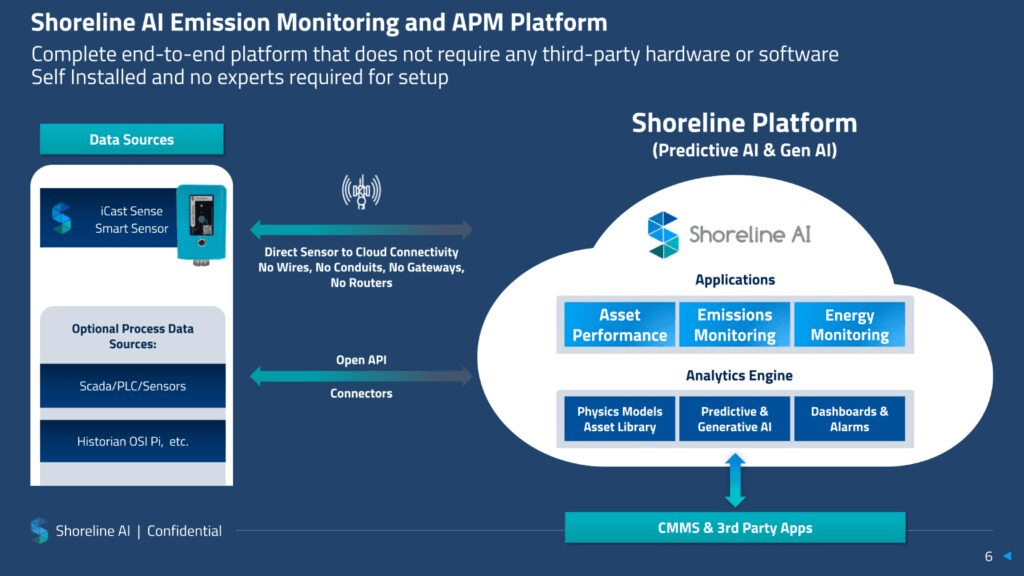
Shoreline’s plug-and-play asset performance management delivers breakthrough simplicity and cost efficiencies. Completely self-installed by non-experts, smart sensors automatically connect to the cloud and are auto-provisioned via a rich library of 30,000+ pre-built asset physics models.


In today’s fast-paced industrial landscape, safety and efficiency are inseparable priorities. Whether it’s oil and gas pipelines, chemical plants, or manufacturing facilities, the risk of undetected gas leaks continues to pose a serious and costly threat. These leaks are often invisible, silent, and difficult to detect until the damage is already done.
This is where AI leak detection steps in as a game-changing innovation. By combining artificial intelligence with sensor networks, data analytics, and automation, AI systems can monitor industrial environments 24/7 — identifying and addressing leaks long before they escalate into disasters.
The result? Improved safety, reduced losses, and millions saved in operational and environmental costs.

Gas leaks are among the most dangerous industrial hazards because they often go unnoticed until it’s too late. A small leak in a pipeline or valve may seem insignificant initially, but over time it can lead to explosions, fires, toxic emissions, or major financial losses.
According to various industry reports, even a minor gas leak detection delay can cost companies hundreds of thousands of dollars per hour due to halted production, wasted resources, and environmental cleanup. The real cost, however, extends beyond money — it’s about lives, safety, and corporate responsibility.
Traditional monitoring systems, while useful, struggle to keep up with the growing scale and complexity of modern industrial infrastructure. Manual inspections and scheduled maintenance routines can’t provide the constant vigilance needed to spot subtle anomalies. That’s why industries are now embracing AI leak detection — a smarter, faster, and more proactive solution.
At its core, AI leak detection leverages artificial intelligence and machine learning to monitor industrial environments in real time. It collects massive volumes of data from IoT sensors, acoustic monitors, thermal cameras, and pressure gauges, and then analyzes this data for irregularities that may indicate a gas leak.
Here’s what sets AI apart: instead of waiting for visible signs or sensor thresholds to trigger an alarm, AI systems predict leaks by recognizing abnormal data patterns and early warning signals. Over time, the system learns from past data, improving its accuracy and reducing false positives.
This predictive and adaptive approach makes AI leak detection far superior to traditional methods, which tend to be reactive and limited in scope.

For decades, industries have relied on manual and semi-automated systems for gas leak detection, including:
While these methods work in certain situations, they share common weaknesses:
In contrast, AI leak detection systems are designed for continuous 24/7 monitoring with precision, consistency, and automated response capabilities.
The brilliance of AI leak detection lies in its ability to integrate data from multiple sources and make intelligent decisions in real time.
Here’s a simplified overview of how it functions:
This 24/7 intelligent monitoring ensures no leak goes unnoticed — whether it’s a slow seepage or a sudden burst.
The adoption of AI leak detection brings measurable operational and financial benefits across industries.
AI detects leaks in their infancy, long before they cause damage. By identifying micro-leaks early, industries prevent massive losses, unplanned downtime, and costly repairs.
Every undetected leak means wasted material, reduced efficiency, and potential regulatory fines. By minimizing losses, AI systems save organizations millions annually while optimizing maintenance costs.
Unlike manual systems, AI-powered monitoring never sleeps. It ensures round-the-clock surveillance across multiple facilities, including remote or unmanned areas.
Human exposure to hazardous gases during manual inspections poses serious risks. With automated gas leak detection, workers are protected from potentially life-threatening environments.
Industries face increasing pressure to meet environmental and ESG goals. AI systems help reduce methane and greenhouse gas emissions, ensuring compliance with safety and sustainability standards.
Machine learning models adapt to normal operational fluctuations, minimizing false positives that can disrupt workflows and waste time.
AI leak detection is transforming safety and efficiency across multiple sectors:
Oil & Gas: Detects methane and hydrocarbon leaks in pipelines, refineries, and storage tanks, minimizing environmental impact.
Chemical Plants: Prevents hazardous gas emissions and ensures compliance with safety regulations.
Manufacturing Units: Monitors equipment and pipelines to prevent downtime caused by leaks.
Utilities: Detects and localizes leaks in city gas distribution systems, reducing losses and ensuring public safety.
From onshore pipelines to offshore rigs, the adoption of AI leak detection is reshaping how industries approach safety and risk management.
A major gas leak doesn’t just result in wasted material — it can lead to production shutdowns, environmental fines, and reputational damage. For example, oil and gas companies report that a single day of downtime in large facilities can cost anywhere from $1 million to $5 million.
By preventing these incidents through early detection, AI leak detection systems offer massive ROI. They enable predictive maintenance, reduce insurance costs, and help companies avoid penalties for environmental non-compliance.
Essentially, the cost of implementing AI technology is negligible compared to the potential savings it delivers.
The evolution of AI leak detection doesn’t stop here. Future systems will combine AI with advanced technologies like edge computing, digital twins, and autonomous drones for instant response and analysis. These innovations will make it possible to detect leaks within seconds, even in complex environments.
Imagine an ecosystem where drones automatically inspect detected leak sites, AI predicts failure points, and maintenance teams receive actionable insights before issues even arise. That’s the future industries are moving toward — safer, smarter, and more sustainable.
Invisible gas leaks are silent threats — but with AI leak detection, they no longer have to be. By combining artificial intelligence, real-time monitoring, and automation, companies can protect assets, safeguard people, and save millions in potential losses.
In an era where safety, sustainability, and cost-efficiency are non-negotiable, AI leak detection isn’t just an upgrade — it’s a necessity. It transforms how industries respond to risks, ensuring that the invisible no longer goes unnoticed
Our solution is highly scalable and affordable.
Domain Expertise is Built-in, eliminating the need and expense of experts, analysts and data scientists all other solutions require to install a solution, configure assets and interpret data.
Fast Time to Value – Plug & Play is realized with a proven, fully automated solution that delivers immediate results – from sensor installation to actionable knowledge in hours, not weeks or months.
Shoreline AI, 1671 Dell Ave, Suite 208, Campbell, CA 95008
info@shorelineai.us
Copyright 2025 Shoreline AI All Rights Reserved.

Let us know how to get back to you.