Mastering the Recip

How Shoreline AI’s High-Fidelity APM Dominates
The Permian Basin’s Toughest Assets

Observations

In the demanding environment of the Permian Basin, reciprocating compressors (recips) serve as the heartbeat of both upstream gathering and downstream processing operations. For major operators in this region, mechanical failure does not merely result in repair costs; it leads to significant production deferment and safety risks.

This case study highlights the expertise of Shoreline AI’s Asset Performance Management (APM) platform in identifying and mitigating critical failures across multiple assets. By leveraging high-fidelity vibration data, spectral analysis, and surface temperature monitoring, Shoreline AI successfully detected mechanical looseness, valve chair failures, and discharge valve leaks before they escalated into catastrophic events. Through these interventions, the operators avoided millions of dollars in potential losses.

The Shoreline AI Approach

The Shoreline AI Approach

Shoreline AI’s dominance in the “recip” space stems from its ability to fuse multiple data streams into actionable intelligence. Unlike traditional threshold-based alarms, the Shoreline AI platform utilizes:

Monitoring broadband energy to detect structural instability.

Isolating specific frequencies (e.g., 1x, 2x, 4-8 kHz) to differentiate between mechanical looseness and internal component wear.

Using surface temperature deviations as a lagging indicator to confirm high-frequency vibration anomalies.

Identifying “crisp” vs. “noisy” valve opening events to pinpoint internal leaks.

Case Analysis

Precision Diagnostics in Action

Case 1 : Resolving Chronic Mechanical Looseness

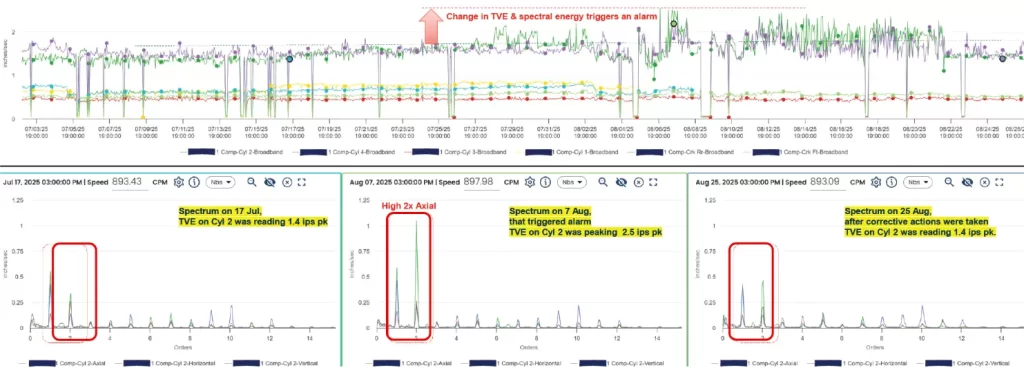
In a midstream application, a reciprocating compressor exhibited high vibration energy on Cylinder 2. An alarm was triggered on August 7, 2025, when TVE levels peaked at 2.5 ips pk.

The Shoreline AI Edge :

The platform’s analyst notes revealed that even after initial maintenance (tightening bolts), the unit continued to show a “signature of looseness” with high 1x/2x levels. This persistent diagnostic forced a deeper inspection, which eventually identified the true culprit: the discharge piping support.

Action :​

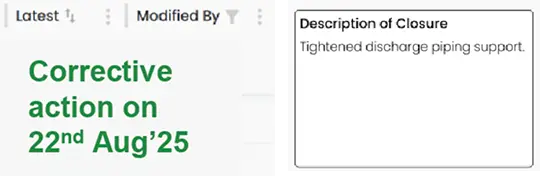
Maintenance crews tightened the specific piping support on August 22, 2025.

Result :

Vibrations were reduced to a stable 1.4 ips pk, and normal operations were restored, preventing potential fatigue cracking of the piping.

Precision Diagnostics in Action

Case 2 : Rapid Response to Valve Chair Failure

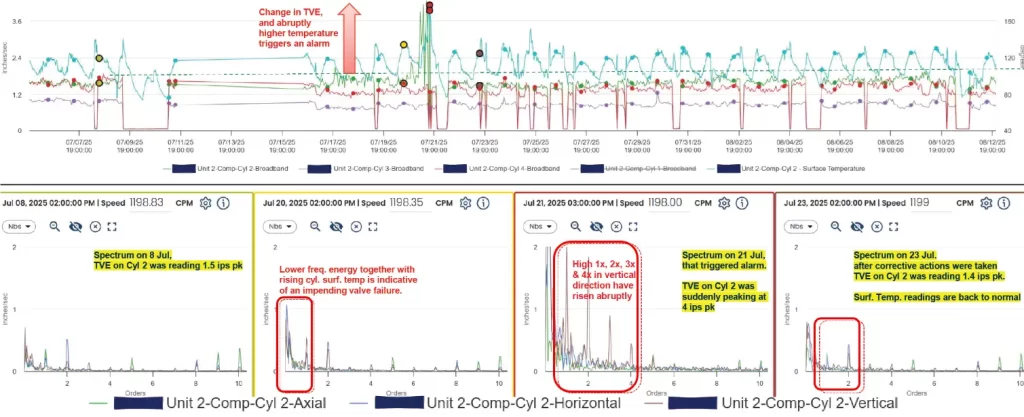
Early detection is critical when internal components begin to disintegrate. On July 21, 2025, an alarm was raised for a unit after TVE levels jumped abruptly from 1.5 ips pk to 4 ips pk.

The Shoreline AI Edge :

The platform detected a simultaneous rise in high 1x, 2x, 3x, and 4x vertical frequencies alongside a spike in surface temperature. Shoreline AI identified this as an impending valve failure.

Action :​

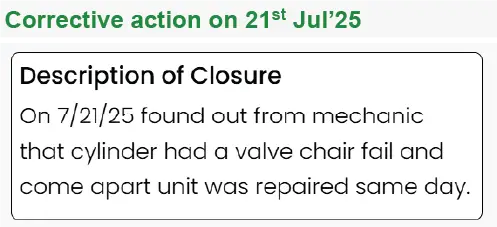
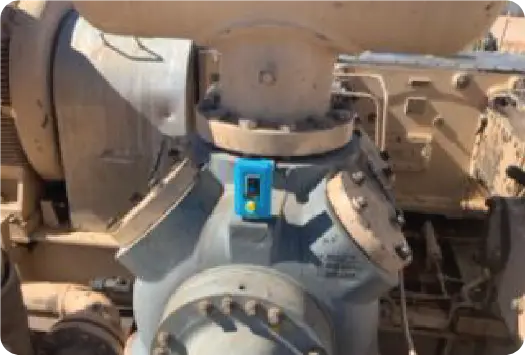
Because the alarm was raised early, a mechanic confirmed a valve chair had failed and come apart. The unit was repaired the same day.

Impact :

By catching the chair failure before the metal fragments could enter the cylinder bore, the operator avoided a complete cylinder overhaul.

Case 3 : Detecting Thermal and Acoustic Deviations

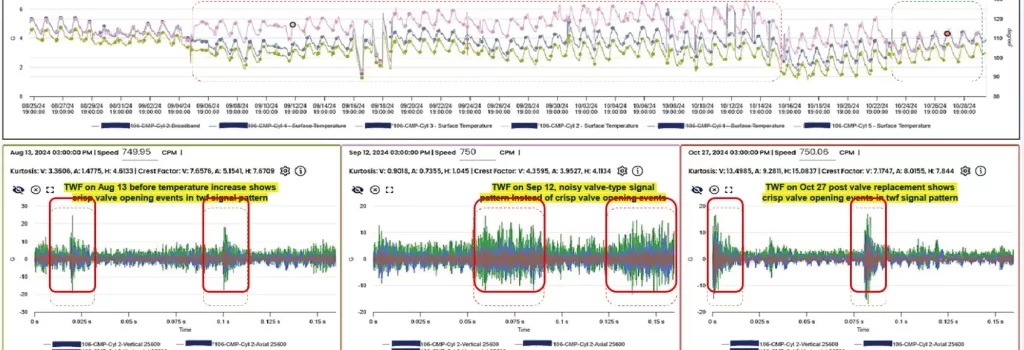
In a separate incident involving a discharge valve, Shoreline AI monitored a Cylinder 2 that began deviating from its peers. While other cylinders operated between 105–115°F, Cylinder 2 rose to 126°F.

The Shoreline AI Edge :

Beyond simple temperature monitoring, the platform analyzed the Time Waveform (TWF). While healthy cylinders showed “crisp” valve opening events, Cylinder 2 showed a “noisy/leaky” signal pattern and increased energy in the 4–8 kHz range.

Action :​

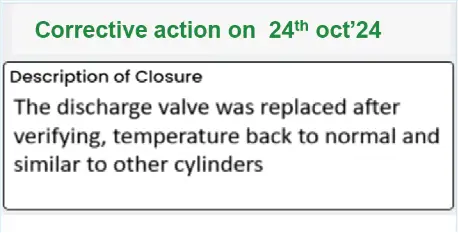
The discharge valve was replaced on October 24, 2024.

Impact :

Post-replacement TWF data showed a return to “crisp” opening events, and temperatures normalized.

Evidence Of Success

Economic Impact : Estimated Cost Savings

(Note : The following financial analysis incorporates industry standards for Permian Basin operations to estimate the value provided by Shoreline AI. This information is based on general market data and should be independently verified.)

In the Permian Basin, a typical large-scale reciprocating compressor can move between 10 to 50 million standard cubic feet of gas per day (MMcfd). The cost of an unscheduled shutdown is multifaceted:

  • Unscheduled downtime for a critical compressor can cost an operator between $10,000 and $50,000 per hour in deferred revenue
  • In Case 2, Shoreline AI enabled a same-day repair. Without predictive alerts, a catastrophic failure could have resulted in 5–7 days of downtime for parts procurement and cylinder boring, totaling an estimated $1.2M to $3.5M in lost production.
  • A valve chair failure (as seen in Case 2) that goes undetected often leads to “slugging” the cylinder. Replacing a ruined piston, liner, and connecting rod can cost upwards of $150,000 to $250,000 in parts and labor per cylinder.
  • In Case 1, preventing piping fatigue failure avoids potential fire risks and environmental fines associated with gas leaks, which can exceed $500,000 in regulatory and remediation costs.
  • By identifying the exact component (e.g., the discharge piping support vs. general foundation bolts), Shoreline AI reduces “wrench time” and unnecessary inspections. This represents an estimated 20% reduction in annual maintenance O&M costs.
Total Estimated Savings Across Three Events:

By preventing catastrophic mechanical damage and minimizing downtime across these three documented cases, Shoreline AI’s platform likely saved the operators a combined $2.5M – $4.5M.

Conclusion:

The complexity of reciprocating compressors in the Permian Basin requires more than just data—it requires expertise. Shoreline AI has proven its ability to detect the subtle “signatures” of failure, from the noisy patterns of a leaky valve to the spectral energy of a loose pipe support.
For upstream and downstream operators, Shoreline AI is not just a monitoring tool; it is a critical safeguard for operational continuity and financial performance.

About Shoreline AI

Shoreline AI’s plug-and-play asset performance management delivers breakthrough simplicity and cost efficiencies. Completely self-installed by non-experts, smart sensors automatically connect to the cloud and are auto-provisioned via a rich library of 30,000+ pre-built asset physics models.

This cloud-native approach requires no new CapEx, on-site experts or data scientists, operationalizing in days and delivering powerful machine-specific analytics. This highly secure, 100% subscription approach creates unprecedented industrial APM economics and scales easily for new applications such as emissions monitoring.

Shoreline AI helps clients in asset-intensive industries maximize the performance and profitability of their operations, create a proactive and predictive approach to asset management, and accelerate sustainability initiatives. The company’s solutions are designed for machinery serving the energy, manufacturing, pharma and data-center cooling industries.