Transforming Downstream Reliability

How a Major North American Refinery Secured Operations and Saved ~$1.9M by Preempting Critical Rotating Equipment Failures

Observations

In the high-consequence environment of downstream energy production, asset reliability is the linchpin of profitability. This case study examines the successful deployment of the Shoreline AI Predictive Maintenance (PdM) platform at a major North American refinery.

By shifting from time-based maintenance to an AI-driven predictive model, the facility successfully identified and resolved two critical developing faults in their rotating asset fleet:

Process Blower (K-XXXXB)

The platform’s deep learning algorithms detected subtle spectral anomalies—specifically structural misalignment and rotor imbalance—weeks before traditional monitoring methods would have flagged them.

This advance warning allowed for:

The Operational Challenge

Refineries operate complex, continuous processes where the failure of a single critical asset can force unplanned shutdowns of entire units (such as Fluid Catalytic Cracking or Sulfur Recovery units). The customer faced a dual challenge:

Aging Critical Assets:

Managing the health of legacy blowers and turbines where replacement parts have long lead times (6–12 months).

Diagnostic Latency:

Traditional route-based vibration analysis often resulted in a "lag," identifying problems only after they had caused secondary damage.

The refinery turned to Shoreline AI to implement continuous, wireless monitoring capable of providing automated root-cause analysis and actionable repair recommendations.

Case Analysis

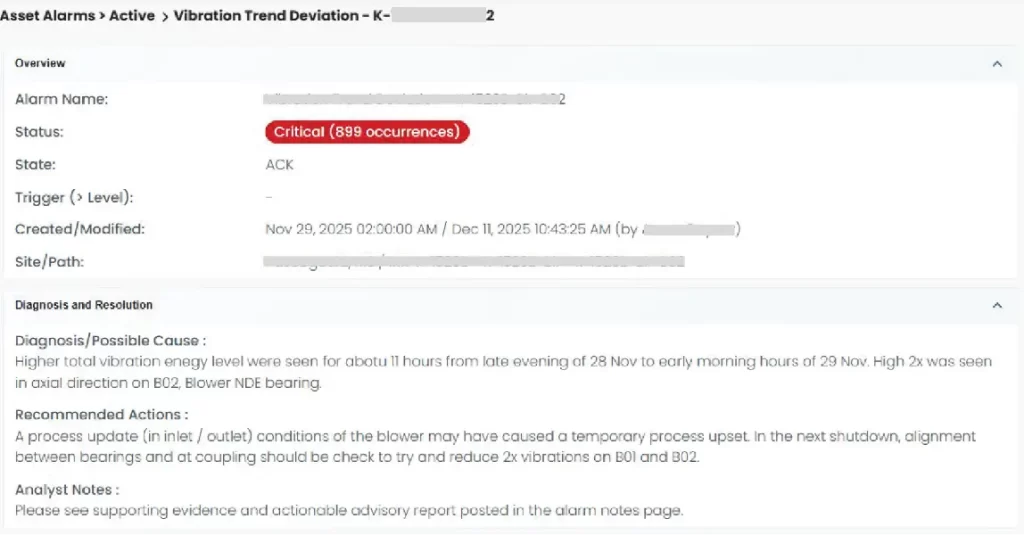
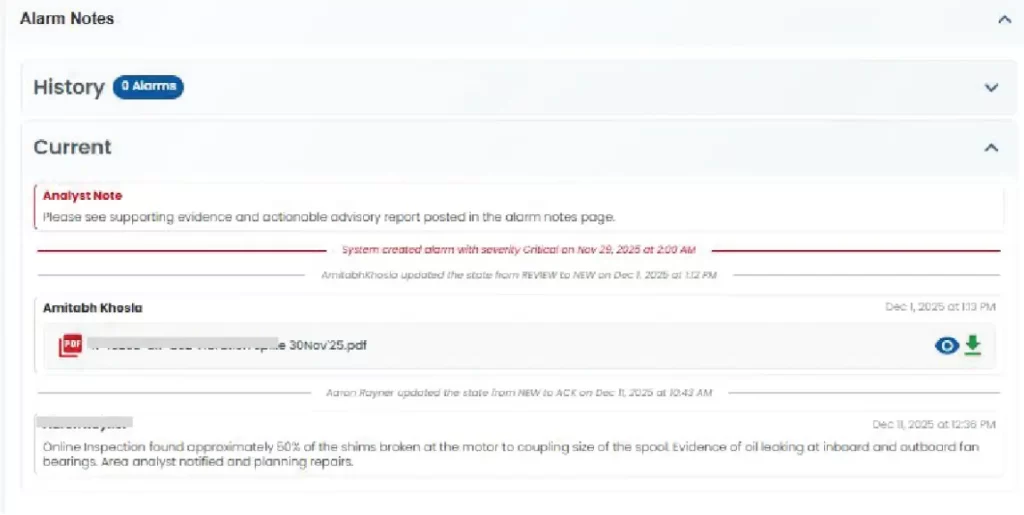
Alarm raised on Shoreline APM Platform

Case 1 : Process Blower (K-XXXXB)

Asset: Critical Process Blower (K-1520B)

Application: Refining Process Unit Air Handling

Fault Detected: Structural Misalignment & Broken Shims

Incident Timeline

The sustained alarm frequency indicated a structural issue, not a transient upset.

November 28, 2025 – 7:30 PM

AI-Driven Diagnostics

The sustained alarm frequency indicated a structural issue, not a transient upset.

  • Spectral Signature: The analysis revealed a dominant peak at 2x Running Speed in the Axial direction.
  • Fault Isolation: Crucially, the high-frequency spectrum showed low energy. This allowed the AI to rule out bearing defects (which typically present in high frequency).
  • Root Cause Analysis: The platform’s automated notes suggested: “A process update (in inlet/outlet) conditions… may have caused a temporary process upset… creating unprecedented axial load”.
  • Recommendation: The system specifically advised the maintenance team to check the alignment between bearings and at the coupling during the next shutdown.

Visual Evidence: The Spectral Shift

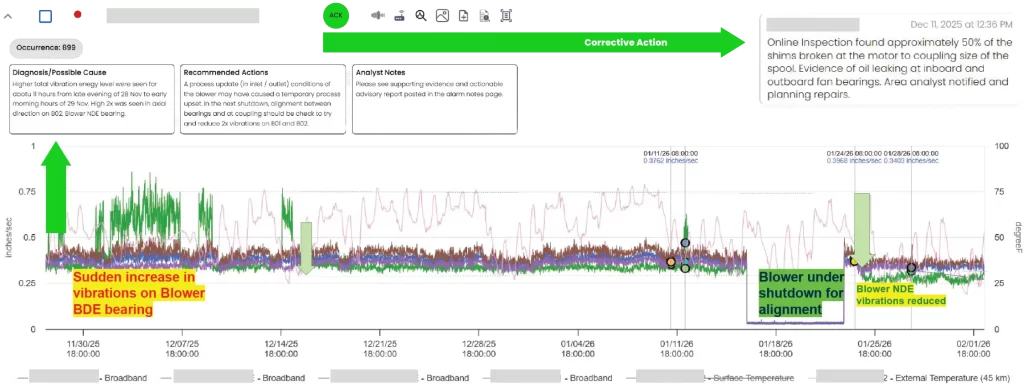
  • Nov 29 (Peak Fault): Vibration velocity spiked to 0.70 ips (inches per second), a level considered dangerous for long-term operation.
  • Dec 1 (Post-Upset): Even after the process upset settled, vibration remained elevated at 0.41 ips, indicating that the event had caused permanent mechanical looseness or damage.

Validation & Resolution

Acting on the specific recommendation to check alignment and couplings, the plant scheduled a targeted intervention.

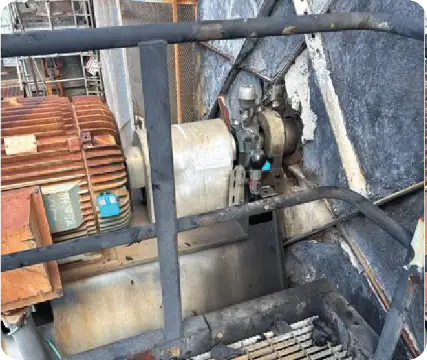
  • The Discovery: Upon inspection, the maintenance team found that approximately 50% of the shims were broken at the motor-to-coupling size of the spool. Additionally, oil leaks were discovered at both inboard and outboard fan bearing
  • The Fix: The team replaced the broken shims, repaired the oil seals, and performed a precision realignment.
  • The Result: Post-maintenance spectral readings on January 26, 2026, showed a dramatic return to health. Vibration levels dropped to 0.26 ips—a ~63% reduction from the peak fault level.
Case 2 : Turbo-Blower (TK-X-XXX C)

Asset: Main Turbo-Blower (TK-X-XXX C)

Application: High-Speed Turbine Drive

Fault Detected: Rotor Imbalance, Blade Shroud Damage & Mechanical Looseness

Incident Timeline

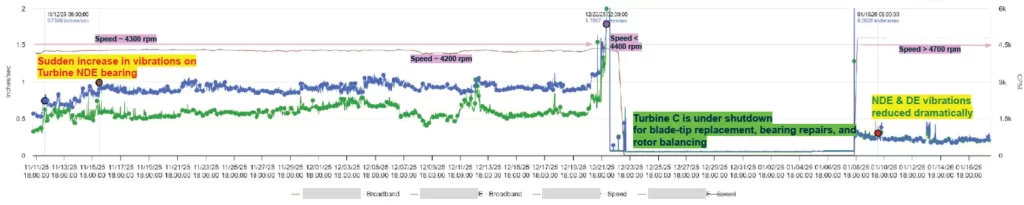
November 15, 2025

Strategic Advantage:

The system provided a 7-day advance notice before failure risk escalated.
This allowed maintenance to shift from emergency trip to a planned shutdown on December 22.

AI-Driven Diagnostics

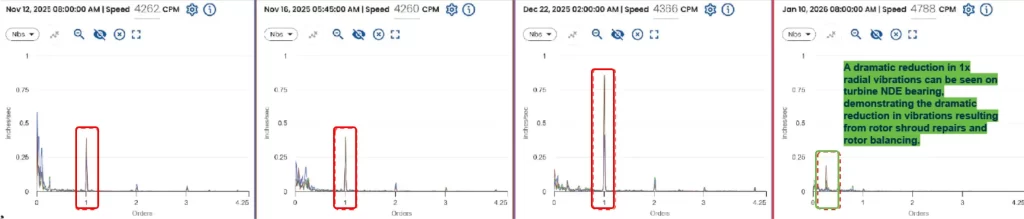
  • Primary Driver: A rapid rise in 1x RPM (Running Speed) vibrations in the radial direction, which is the classic signature of rotor imbalance.
  • Secondary Drivers:
    2x Peaks: Indicating mechanical looseness in foundation or coupling bolts.
    Sub-harmonic Energy: Suggesting instability in the oil-slinger ring.
  • Analyst Note: “The looseness seems to have worsened rapidly over the weekend… assuming sudden change in balance condition”.

Visual Evidence: Operational Optimization

  • Before Repair (Nov 12 – Nov 16): The machine was constrained. At speeds of 4,260 RPM, vibration levels were unstable and rising..
  • After Repair (Jan 10, 2026): Following the intervention, the spectral charts show a “dramatic reduction” in 1x radial vibrations.
  • Performance Unlock: Most notably, the asset is now running at >4,700 RPM—a significant increase in operational speed that directly correlates to higher process throughput.

Validation & Resolution

During the planned shutdown on December 22, the maintenance team executed a major overhaul based on the AI’s “Imbalance and Looseness” diagnosis.

  • The Fix:
    a. Replaced turbine bearings.
    b. Repaired turbine rotor blade shrouds (confirming the imbalance source).
  • The Result: The asset was returned to service with higher reliability and higher capacity.

Financial Impact & ROI Analysis

The financial value of Shoreline AI is calculated by comparing the Actual Cost (Planned Repair) against the Avoided Cost (Catastrophic Failure & Unplanned Downtime).

Combined Estimated Savings
Cost CategoryScenario A: Turbo-Blower (TK-K-6418 C)Scenario B: Process Blower (K-1520B)Total Impact
Asset RiskHigh: Rotor imbalance and shroud damage often lead to "blade liberation," destroying the rotor and casing.Medium: Broken shims lead to coupling seizure or shaft bending.
Avoided Replacement Cost$850,000*(Cost of new custom rotor/casing: $950k - Repair cost: $100k)*$40,000*(Cost of shaft repair/motor rewind: $50k - Shim repair: $10k)*$890,000
Avoided Production Loss$1,000,000*(5 days downtime @ $200k/day)Note: The 7-day advance notice allowed repairs to move to a planned window.*Minimal*(Assumed redundancy or short repair window)$1,000,000
Performance Gain+12% Capacity*(Speed increased from ~4200 to >4700 RPM)*Reliability RestorationOperational Efficiency
TOTAL ESTIMATED SAVINGS~$1,850,000~$40,000~$1,890,000
  • Avoided Catastrophe (Turbo-Blower): The discovery of “rotor blade shroud” damage is significant. Had this gone undetected, a blade detachment at 4,200 RPM would have likely penetrated the casing, causing a safety incident and requiring a full asset replacement with a 6+ month lead time
  • Production Upside: By enabling the Turbo-Blower to run at 4,788 RPM (up from 4,262 RPM), Shoreline AI didn’t just save money on repairs; it unlocked additional production capacity, likely increasing the daily margin of the associated process unit

Conclusion:

The adoption of Shoreline AI at this North American refinery demonstrates the transition from reactive “fire-fighting” to proactive asset management.

  • Precision: The system correctly distinguished between standard bearing wear and complex structural issues like broken shims (Case 1 ) and rotor shroud damage (Case 2 ).
  • Speed: In the case of the Turbo-Blower, the 7-day advance notice was the critical factor that converted a potential million-dollar emergency into a manageable maintenance event.
  • Value: With a combined estimated saving of $1.89 million from just two assets, the ROI of the Shoreline AI deployment was realized almost immediately.

By digitizing asset health, the refinery has secured its operations against the high cost of unplanned downtime, ensuring that critical machinery supports, rather than hinders, production goals.

About Shoreline AI

Shoreline AI’s plug-and-play asset performance management delivers breakthrough simplicity and cost efficiencies. Completely self-installed by non-experts, smart sensors automatically connect to the cloud and are auto-provisioned via a rich library of 30,000+ pre-built asset physics models.


This cloud-native approach requires no new CapEx, on-site experts or data scientists, operationalizing in days and delivering powerful machine-specific analytics. This highly secure, 100% subscription approach creates unprecedented industrial APM economics and scales easily for new applications such as emissions monitoring.

Shoreline AI helps clients in asset-intensive industries maximize the performance and profitability of their operations, create a proactive and predictive approach to asset management, and accelerate sustainability initiatives. The company’s solutions are designed for machinery serving the energy, manufacturing, pharma and data-center cooling industries.