Timely Alert from Shoreline AI Prevents NGL Pipeline Shutdown

Company: Midstream Pipeline Operator

Asset: Critical NGL Pipeline Pump

Executive Summary

In midstream oil and gas pipeline operations, sudden pump failures lead to severe operational bottlenecks, environmental risks, and millions of dollars in lost throughput. At a major Natural Gas Liquids (NGL) pumping station operated by a leading midstream company, Shoreline APM’s Physical AI generated a Critical severity alarm, alerting the maintenance team to early-stage distress in a pump’s thrust bearing. By providing a precise fault diagnosis and isolating the high-frequency vibration specifically to the thrust bearing, Shoreline AI empowered the maintenance team to perform a targeted, proactive bearing replacement before a catastrophic failure could occur. This well-informed, timely intervention restored normal operations and successfully helped the operator avoid critical downtime and costly emergency rebuilds.

Background & Process Context

In midstream infrastructure, NGL pumping stations are essential for transporting separated liquid byproducts (such as ethane, propane, and butane) through long-distance pipelines to downstream fractionation & refining facilities. The pumps at these stations are high-pressure, multi-stage units operating under immense axial and radial hydraulic loads.

Because NGLs have low specific gravities and are pumped near their vapor pressures, these pumps are highly susceptible to flow instability, cavitation, which in turn can cause thrust bearing wear. If a thrust bearing fails during operation, the pump shaft can violently shift along its axis. This axial movement allows the high-speed rotor parts to grind into the stationary parts of the pump casing, destroying the mechanical seals, wearing rings, impellers and sometimes  the casing itself, turning a $5,000 bearing replacement job into a $200,000+ pump wreck and a multi-day pipeline outage.

Supporting Data

The Challenge: A Stealthy Rise in High-Frequency Energy

A Stealthy Rise in High-Frequency Energy

Throughout the spring and early summer of 2026, the targeted NGL pump appeared to be functioning normally to the naked eye. The temperature trend of the bearings did not show any significant changes.

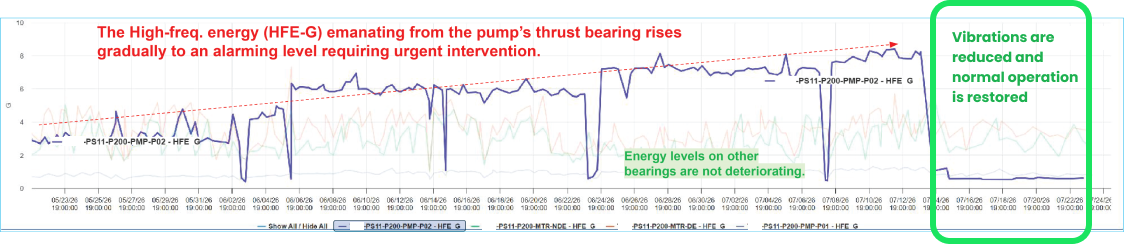
However, Shoreline APM’s continuous monitoring detected a gradual but steady increase in High-Frequency Energy (HFE-G) emanating specifically from the pump’s thrust bearing, housed in the POB housing. Energy levels on the pump’s other bearings were not deteriorating, meaning the issue was highly localized.

By mid-July, the anomaly worsened significantly:
  • Total Vibration Energy (TVE) showed an increase in amplitude from 0.13 to 0.2 ips pk.
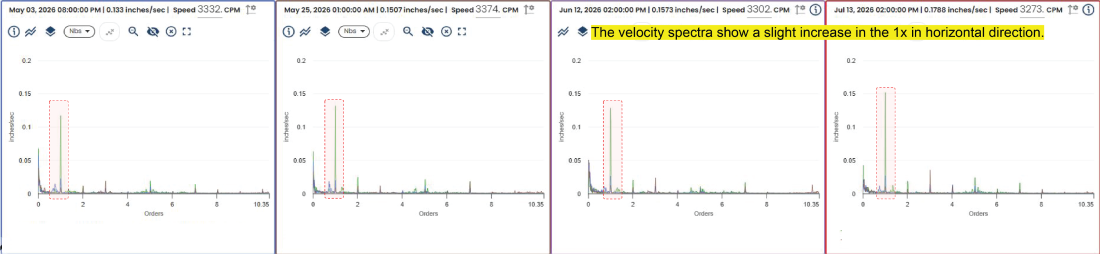
  • The velocity spectrum showed a rising 1x amplitude in the horizontal direction.
  • Most concerningly, the acceleration spectrum revealed a dominant  peak—at one of the fundamental frequencies associated to the specific rolling element bearing.
The Diagnosis:

Shoreline APM Physical AI Analytics

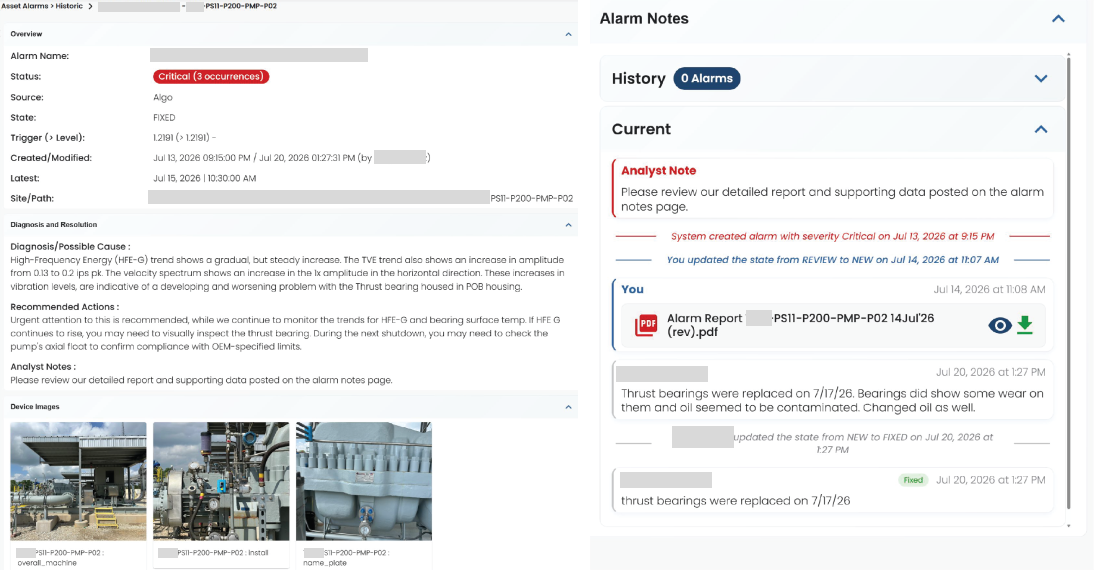
On July 13, 2026, the rising High freq. energy (G)  trend reached critical thresholds, prompting the Shoreline APM Physical AI to generate a Critical severity alarm.

Shoreline APM Physical AI Analytics

Shoreline APM did not just flag high vibrations; it provided a highly detailed fault diagnosis. The Shoreline AI concluded that the 7x (BPIF) vibration peaks and the rising broadband energy were indicative of distress on the thrust bearing.

The Shoreline analysts also provided actionable advice addressing the root causes associated with hydraulic instability and repeated recirculation events, noting that if the pump was experiencing suction-end recirculation under low-flow conditions, it would alter the hydraulic balancing and severely increase axial thrust loads, thereby artificially degrading the bearing’s lifespan. The platform recommended urgent attention, continuous monitoring of the HFE-G, and a visual inspection of the bearing elements, cage integrity, and lubrication conditions during the next shutdown.

Evidence Of Success

Corrective Action and Resolution

Armed with diagnostic certainty from Shoreline APM, this midstream operator took proactive corrective action. Within the same week, the maintenance team took the pump offline in a controlled, pre-planned manner and replaced the thrust bearings.

The physical inspection completely validated the Shoreline AI’s diagnosis: the removed bearings showed visible wear, and the lubricating oil was found to be contaminated. The team changed the oil and installed the new bearings.

The results were immediate and undeniable. Upon restarting the pump, the platform showed remarkably lower HFE-G levels, reducing vibrations entirely and restoring normal, safe operations.

NGL Pump Thrust Bearing Vibration Alert
The results were immediate:
Asset Alarm Notes

Business Impact & Avoided Costs

Without Shoreline APM’s Physical AI catching the high-frequency distress before temperature gauges could even register a problem, this pump was on a direct trajectory toward a catastrophic, run-to-failure event. 

Had the thrust bearing failed while the pump was operating at full speed,  a damaged thrust bearing would have resulted in an axial shaft shift, possibly destroying the impellers and casing. Rebuilding a high-pressure NGL pipeline pump routinely costs $100,000 to $250,000 in parts and specialized labor. By catching it early, the operator only spent less than $10,000 for a timely bearing replacement and an oil-change.

If this NGL pumping station was bottlenecked without a redundant backup, deferred pipeline throughput could cost the midstream operator $150,000 to $300,000+ per day. A catastrophic wreck would take the pump offline for at least 2 to 3 days, leading to potential revenue delays of $300,000 to $900,000.

By successfully transitioning from reactive to predictive maintenance using Shoreline APM, the operator likely saved between $400,000 and $1.15 Million in combined physical damages, emergency labor, and lost production/throughput opportunities.

Had the pump run to catastrophic failure without the APM alerts, the estimated potential savings lost would be substantial:

Had the thrust bearing failed while the pump was operating at full speed,  a damaged thrust bearing would have resulted in an axial shaft shift, possibly destroying the impellers and casing. Rebuilding a high-pressure NGL pipeline pump routinely costs $100,000 to $250,000 in parts and specialized labor. By catching it early, the operator only spent less than $10,000 for a timely bearing replacement and an oil-change.

If this NGL pumping station was bottlenecked without a redundant backup, deferred pipeline throughput could cost the midstream operator $150,000 to $300,000+ per day. A catastrophic wreck would take the pump offline for at least 2 to 3 days, leading to potential revenue delays of $300,000 to $900,000.

By successfully transitioning from reactive to predictive maintenance using Shoreline APM, the operator likely saved between $400,000 and $1.15 Million in combined physical damages, emergency labor, and lost production/throughput opportunities.

Conclusion:

Shoreline APM detected early-stage thrust bearing degradation before it could develop into a catastrophic failure. By accurately identifying the fault and providing clear maintenance recommendations, the platform enabled a planned bearing replacement during a controlled shutdown.

This proactive approach restored normal pump operation, eliminated high-frequency vibration, and helped the operator avoid major equipment damage, unplanned downtime, and emergency repair costs. By transitioning from reactive to predictive maintenance, the operator achieved safer, more reliable asset performance while avoiding an estimated $400,000 to $1.15 million in potential repair and production losses.

About Shoreline AI

Shoreline AI’s plug-and-play asset performance management delivers breakthrough simplicity and cost efficiencies. Completely self-installed by non-experts, smart sensors automatically connect to the cloud and are auto-provisioned via a rich library of 30,000+ pre-built asset physics models.

This cloud-native approach requires no new CapEx, on-site experts or data scientists, operationalizing in days and delivering powerful machine-specific analytics. This highly secure, 100% subscription approach creates unprecedented industrial APM economics and scales easily for new applications such as emissions monitoring.

Shoreline AI helps clients in asset-intensive industries maximize the performance and profitability of their operations, create a proactive and predictive approach to asset management, and accelerate sustainability initiatives. The company’s solutions are designed for machinery serving the energy, manufacturing, pharma and data-center cooling industries.